


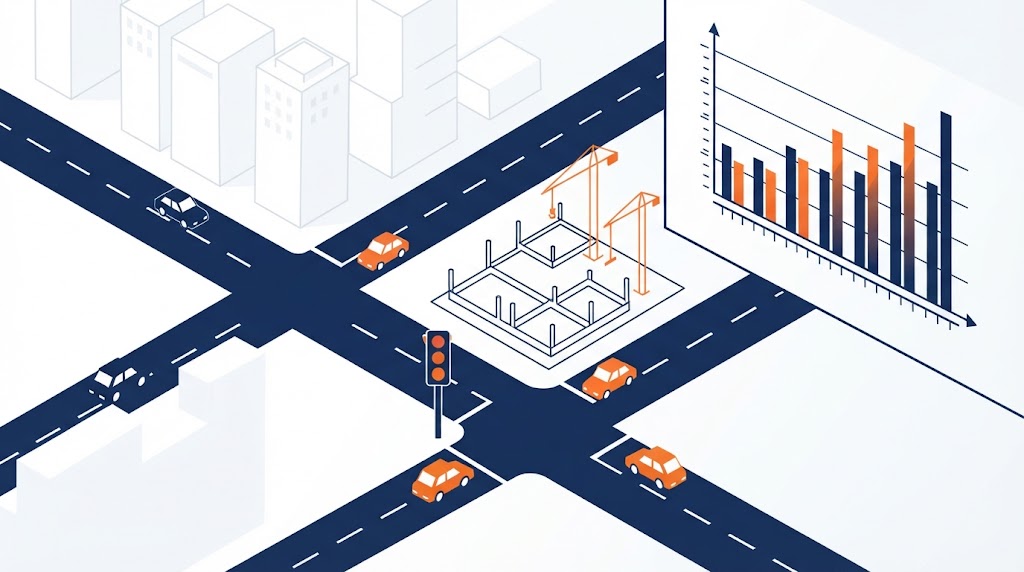
A traffic impact assessment (TIA) is an engineering study that predicts how a new development will change traffic, safety and access on the roads around it. Planning authorities use it to decide whether to approve a project, and what road fixes to demand. If you’re a developer, architect or plot owner in Pakistan, this guide covers when you need one, what it costs, how it works, and where reports get rejected. There’s a worked sample too.
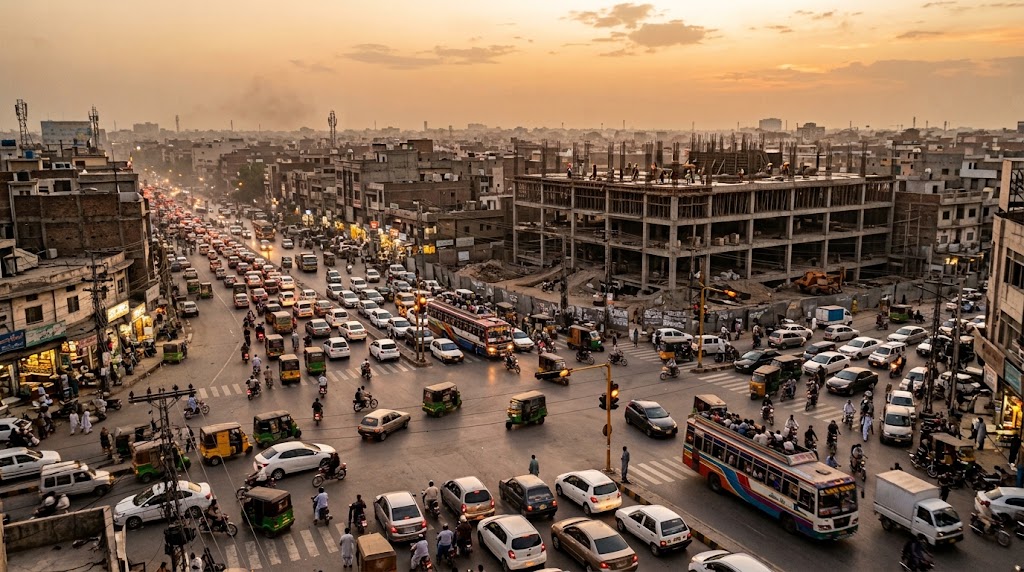
What Is a Traffic Impact Assessment (TIA)?
Think of it as a forecast. You’re asking one question: when this building opens, what happens to the road outside it?
The study counts the traffic that’s already there, estimates the new trips your project will add, and tests whether nearby junctions can cope. If they can’t, the report proposes fixes. Turn lanes, signal timing, a wider access road, a relocated gate.
Purpose of a TIA
A TIA does four jobs.
- It predicts how many extra cars, motorcycles, buses and pedestrians the project will bring.
- It flags future jams and safety risks before anything gets built.
- It recommends road changes, so the cost lands on the project rather than on the public.
- It gives planners hard data to approve, modify or refuse a building plan.
Honestly, that last point is why most developers in Pakistan end up commissioning one. The study is rarely a goal in itself. It’s the paper your approval depends on.
TIA vs TTA vs TIS vs EIA: What’s the Difference?
These terms get mixed up constantly. Here’s the short version.
| Term | Full name | What it covers |
|---|---|---|
| TIA | Traffic Impact Assessment | Effect of one development on nearby roads and junctions |
| TIS | Traffic Impact Study | Usually the same thing as a TIA; authorities pick whichever name they prefer |
| TTA | Traffic and Transport Assessment | Wider scope: also looks at public transport, walking, cycling and parking |
| EIA | Environmental Impact Assessment | Environmental effects (air, noise, ecology). Traffic is only one small part |
So a TIA and a TIS are mostly the same document. A TTA is the bigger cousin. An EIA is a different study entirely, although it may quote your TIA numbers. Check which one your authority actually asks for. (Some call it a TIA in the bylaws and a TTA in the checklist. Yes, it’s confusing.)
Is a Traffic Impact Assessment Required for Your Project?
Usually, if the project is big enough to move the traffic needle. Small houses don’t need one. A 400-unit housing scheme almost certainly does.
Project Types That Usually Need a TIA
- Housing schemes and large apartment blocks
- Commercial plazas and shopping malls
- Hospitals and universities
- Schools with large enrolments
- Industrial estates and warehouses
- Petrol stations and drive-through restaurants on busy roads
What do these have in common? They all pull in lots of vehicles at predictable peak hours.
Size Thresholds That Trigger a TIA
Thresholds differ by authority, and they change. Use the table below as a template and fill it from the official source.
| Project type | Typical trigger | Source |
|---|---|---|
| Residential scheme | [VERIFY: number of units or plots] | [VERIFY: authority bylaw] |
| Commercial plaza / mall | [VERIFY: covered area in sq ft or sq m] | [VERIFY] |
| Hospital / university | [VERIFY: beds or enrolment] | [VERIFY] |
| Industrial site | [VERIFY: area or expected truck trips] | [VERIFY] |
When a TIA May Not Be Required
Small single-use buildings on quiet local streets are often exempt. But “often” isn’t “always.” If your site sits near a congested junction or a school, the authority can still ask for a study. Get the exemption in writing, not on a phone call.
TIA Requirements by Authority in Pakistan
There’s no single national TIA rulebook that I’m aware of. Each development authority sets its own, and some don’t publish much. The paragraphs below point you to the right place to look. Confirm every detail before relying on it.
LDA (Lahore)
The Lahore Development Authority handles approvals for large commercial and housing projects in Lahore. Ask the relevant LDA wing for the current TIA terms of reference, and whether the study must be prepared by an approved consultant.
MDA (Multan)
The Multan Development Authority publishes a 15-page Traffic Impact Assessment Study guideline, which defines a TIAS as a technical appraisal of the traffic and safety implications of a specific development. Download it and follow its report structure exactly. It’s the most useful public document on this topic that I’ve seen from a Pakistani authority. [VERIFY: current version and thresholds]
CDA (Islamabad)
The Capital Development Authority reviews major projects in Islamabad. Requirements usually come through the building control or planning wing. [VERIFY: CDA TIA requirement and submission route]
KDA / SBCA (Karachi)
In Karachi, approvals are split between the Sindh Building Control Authority and other agencies depending on the land type. Ask which body handles your plot before you commission anything. [VERIFY: SBCA / KDA requirement]
Other Authorities and Private Housing Scheme Approvals
Provincial housing departments, cantonment boards and district development authorities each have their own habits. Private scheme approvals in particular can ask for a TIA at the NOC stage. Your best move: write to the authority, ask for the terms of reference, and keep the reply on file.
Traffic Impact Assessment Process: Step by Step
The steps are fairly standard worldwide. What changes in Pakistan is the data and the traffic mix.
Step 1: Scoping and Study Area
Decide which roads and junctions to study, and which hours. Usually that’s the morning and evening peaks, plus a weekend peak for retail. A good rule of thumb: include every junction your project’s traffic will use within roughly 500 m to 1 km. Agree this with the authority before you spend money on counting.
Step 2: Data Collection (traffic counts, speeds, crash history)
This means classified traffic counts at each junction, vehicle speeds, and any crash records you can get. Count for at least a typical weekday, ideally a few. Avoid holidays, Ramadan evenings and strike days unless your project depends on them.
Separate your counts by vehicle type. Cars, motorcycles, rickshaws, buses, trucks, handcarts. You’ll need that split in a minute.
Step 3: Trip Generation
Here you estimate how many trips the project will create. Most consultants start from standard trip rates (the ITE Trip Generation Manual is the common reference) and then adjust for local conditions, because Western rates overstate car use and understate motorcycles. Ideally you’d back them up with surveys of similar sites nearby.
Step 4: Trip Distribution and Assignment
Where will these trips come from, and which roads will they take? Distribution splits the new trips by direction. Assignment places them on specific routes and turning movements. Use the surrounding population, existing traffic patterns, and common sense. If every customer must turn right across a busy road, the model should show it.
Step 5: Traffic Analysis (with and without the project)
Run the numbers twice. First for the future year without your project. Then with it. Compare the level of service (LOS) at each junction, a grade from A (free flow) to F (breakdown). Also check queue lengths and delay. The gap between the two scenarios is your project’s impact.
Step 6: Mitigation Measures
If a junction fails, propose fixes: extra lanes, a dedicated right-turn bay, signal retiming, a better access position, or in-site changes like a longer internal queue lane. Test the fix. A mitigation measure you haven’t modelled is just a wish.
Step 7: Report Preparation and Submission
Pull everything into one report: project description, data, methods, results, mitigation and drawings. Follow the authority’s format. Submit, wait for comments, and expect at least one round of revisions.
How Mixed Traffic Changes a TIA in Pakistan
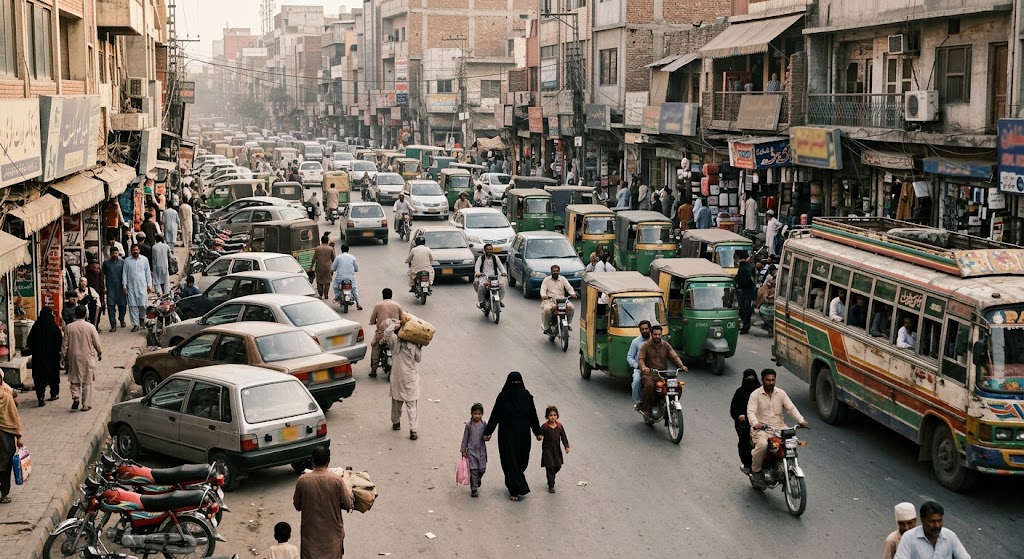
Most TIA guidance was written for roads full of cars. Pakistani roads aren’t. A textbook method applied without adjustment can give you a tidy report that doesn’t match what anyone sees on the street.
Passenger Car Units (PCU) for Rickshaws, Motorcycles and Buses
To compare unlike vehicles, engineers convert them into passenger car units. One car is 1.0 PCU. A bus counts for more, a motorcycle for less. [VERIFY: the PCU factors your authority or local studies accept, such as those in local road design manuals] Use agreed values, state them in the report, and don’t change them halfway through.
On-Street Parking and Roadside Activity
Parked cars, hawkers and stopped rickshaws shrink the usable road. A four-lane road might behave like a two-lane one near a busy market. Record it during the count, and reduce the capacity in your model to match. Ignoring this is probably the single most common reason a model looks too optimistic.
Pedestrians and Informal Crossings
People cross where it’s convenient, not where the zebra crossing is. If your project draws foot traffic, say a school or a hospital, count pedestrians and look at where they actually cross. Then design the mitigation around that behaviour. A footbridge nobody uses fixes nothing.
Traffic Impact Assessment Cost in Pakistan
People ask this first, and nobody publishes a straight answer. I can’t give you reliable figures without current quotes, so the table below is a framework to fill in.
Typical Cost Ranges by Project Type
| Project type | Scope | Typical fee (PKR) |
|---|---|---|
| Small commercial building | 1–2 junctions, one peak | [VERIFY: collect quotes] |
| Medium plaza or school | 3–5 junctions, two peaks | [VERIFY] |
| Large housing scheme or mall | Wide network, detailed modelling | [VERIFY] |
| Hospital / industrial estate | Special vehicle mix | [VERIFY] |
Get at least three quotes from consultants and publish the range you actually see. That one table could make this page more useful than anything else ranking for it.
Factors That Affect the Price
- Number of junctions in the study area
- How many peak periods you count
- Whether the authority insists on an approved or registered consultant
- Need for survey crews, video counts or drones
- Complexity of the mitigation design, including drawings
- Revision rounds. Some firms include them; others charge extra.
How to Get an Accurate Quote
Send each consultant the same package: site plan, land use, floor areas, location, and the authority’s terms of reference. Ask what’s included. Counts? Drawings? Two rounds of comments? A vague quote usually becomes an expensive one later.
How Long Does a TIA Take?
Typical Timeline by Project Size
Small studies can wrap up in a few weeks. Larger ones take longer, mostly because of survey scheduling and authority comments.
Where the TIA Fits in the Approval Process
Start early. A TIA often has to be submitted before the layout plan or building plan is approved, and mitigation can force changes to your access points or parking. Finding that out after you’ve finalised drawings is painful. Commission the study at the concept stage if you can.
Traffic Impact Assessment Example (Worked Sample)
The figures below are hypothetical, built to show the method. Don’t copy them into a real submission.
Project Description and Assumptions
A 60,000 sq ft commercial plaza, with retail on the lower floors and offices above, on a two-lane urban arterial. One access point. Evening peak is the critical hour.
Assumed evening peak trip rate (illustrative): 3.5 vehicle trips per 1,000 sq ft after local adjustment. [VERIFY against survey data or a recognised rate source]
Trip Generation Calculation
60,000 sq ft ÷ 1,000 = 60 units
60 × 3.5 = 210 vehicle trips in the evening peak hour
Say 60% enter and 40% exit. That’s roughly 126 vehicles in and 84 out.
Distribution and Level of Service (Before vs After)
Suppose 70% of trips use the main road from the east and 30% from the west. Existing counts show the nearest junction at LOS C in the evening peak. After adding the project traffic, the model shows LOS E, with right-turn queues backing up past the access.
| Scenario | Junction LOS | Average delay |
|---|---|---|
| Without project | C |
Recommended Mitigation
Add a right-turn bay on the main road, move the gate 40 m further from the junction, and retime the signal for the evening peak. Re-run the model with these fixes and show the improved LOS. That re-run is what convinces a reviewer.
Sample TIA Report Outline (link to download)
- Executive summary
- Project description and location
- Study area and scope
- Existing conditions (counts, speeds, crashes)
- Trip generation, distribution and assignment
- Future traffic analysis, with and without the project
- Mitigation measures and re-analysis
- Parking and access review
- Conclusions and recommendations
- Appendices (raw counts, calculations, drawings)
[Insert download link]
Why TIAs Get Rejected: Common Mistakes
What do reviewers send back most often? From what I’ve seen, the same handful of problems.
Outdated or Insufficient Traffic Counts
Counts from years ago, or from one odd day. Reviewers want recent, representative data, with dates and locations shown.
Wrong Trip Generation Rates
Using foreign rates with no local adjustment, or picking a land-use category that doesn’t match your project. Explain every rate you use.
Ignoring Mixed Traffic and Parking
A model that treats every vehicle as a car, and assumes the kerbside lane is empty. It won’t match what the reviewer drove past that morning.
Weak or Unrealistic Mitigation
“Widen the road” when there’s no land to widen into. Mitigation has to be buildable, and within the developer’s reach.
Missing Authority-Specific Requirements
The wrong format, missing drawings, no signed consultant details. Boring, but it happens all the time. Read the terms of reference twice.
Free TIA Checklist and Report Template
Submission Checklist
- Terms of reference received from the authority
- Study area and peak hours agreed
- Classified counts with dates, times and locations
- Trip generation rates documented and justified
- PCU factors stated
- Parking and access reviewed
- Mitigation modelled and drawn
- Report follows the required format
- Consultant details and signatures included
Downloadable Report Template
How to Choose a Traffic Impact Assessment Consultant
Qualifications to Look For
A transportation or highway engineering background, relevant experience with your authority, and sample reports you can read. Registration with the Pakistan Engineering Council is worth checking. [VERIFY: whether your authority requires it]
Questions to Ask Before Hiring
- Have you submitted TIAs to this authority before?
- Who does the field counts, and who checks them?
- What’s included in the fee? Revisions, drawings, meetings?
- How will you handle mixed traffic in the model?
- What happens if the authority rejects the report?
Frequently Asked Questions
What are the steps involved in the traffic impact assessment process?
A traffic impact assessment usually follows seven steps:
- Scoping: agree the study area, peak hours and junctions with the authority.
- Data collection: record traffic counts, speeds and crash history.
- Trip generation: estimate how many trips the new project will create.
- Trip distribution and assignment: work out where those trips come from and which roads they’ll use.
- Traffic analysis: compare future conditions with and without the project, using level of service (LOS) and delay.
- Mitigation: design fixes such as turn lanes, signal changes or a relocated access.
- Reporting: compile the report and submit it for review.
Most reviewers send it back at least once. So don’t plan for a single submission.
How much does a traffic impact study cost?
It depends. Nobody can quote a fair price without knowing the project, and anyone who does is guessing. The fee mostly comes down to five things:
- How many junctions are in the study area
- How many peak periods you count
- Whether the authority requires an approved consultant
- How complex the mitigation design is, including drawings
- How many revision rounds are included
A small study on one or two junctions costs far less than a wide-network study for a large housing scheme or mall. [VERIFY: add the PKR range from at least three consultant quotes] Ask each consultant exactly what’s included before you compare prices, because a cheap quote that leaves out the drawings isn’t cheap.
What is the purpose of an impact assessment?
A traffic impact assessment shows how a new development will affect nearby roads, traffic flow and safety before it’s built. It does three things: it predicts the new traffic, flags the problems that will follow, and proposes fixes. Planners then use it to approve, change or refuse the project. In practice, it’s the evidence that your project won’t leave the public with a jammed road.
Can you provide an example of a traffic impact assessment?
Yes, here’s a simplified one (the numbers are hypothetical). Take a 60,000 sq ft commercial plaza on a two-lane arterial road.
Mitigation: a right-turn bay, a gate moved 40 m from the junction, and retimed signals bring the junction back to about LOS C or D.
Trip generation: at an assumed 3.5 trips per 1,000 sq ft, the plaza creates about 210 trips in the evening peak hour (roughly 126 in, 84 out).
Analysis: the nearest junction works at LOS C today. With the plaza’s traffic added, it drops to LOS E.
Is a TIA mandatory for housing schemes in Pakistan?
For larger schemes, authorities commonly ask for one, but rules vary by city and change over time. Confirm with the approving authority.
How long is a TIA valid?
There’s no universal answer. Some authorities treat counts older than a set period as outdated. Ask yours.
Conclusion
A traffic impact assessment isn’t a formality. Done well, it saves you from a rejected plan, a jammed entrance, or a costly redesign after construction starts. Start early, follow your authority’s terms of reference, and model Pakistani traffic as it actually behaves.